
Business Growth Feels Different at Every Stage
The Real Nature of Business Growth
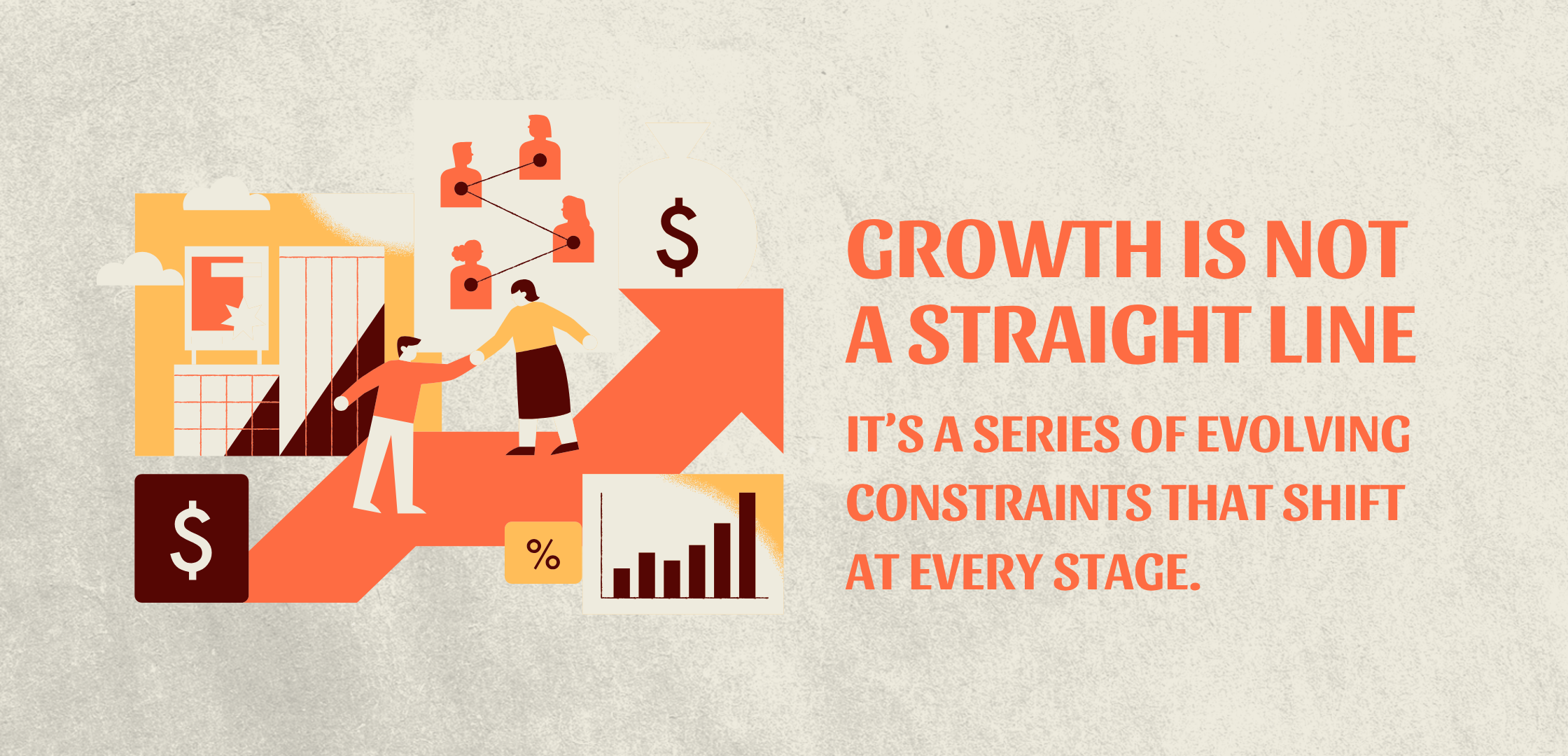
Growth is often treated as a straightforward process. More effort, and marketing, result in positive outcomes.
But in reality, business growth unfolds in distinct stages, each with its own set of challenges to solve. A business evolves across multiple dimensions: product, market fit, operations, financial structure, and team maturity. At every stage, the role of marketing, strategy, and decision-making shifts.
What works in one stage can fail in the next. Growth changes the problem, but many founders don’t adjust their strategy.
When the wrong priorities are set, mistakes compound and become harder to reverse.
Which means the real challenge is not how much effort is being put in.
It is whether the right problem is being understood in the first place.
Stage 1: When the Problem is Demand
In its early stages of expansion, the company is still attempting to establish its worth in the marketplace. The emphasis is not on scale, but on validation. Founders are putting their offer to the test, fine-tuning their positioning, and determining who genuinely values what they are producing. Even while revenue is coming in, it frequently feels erratic because the foundation is still being built.
Success at this point is more about learning precisely than it is about doing more. Particularly when resources are scarce, efforts should be focused on raising awareness, comprehending consumer behaviour, and making every marketing choice matter. Scaling too soon, before demand is distinct and consistent, frequently results in budget waste and disorganised communications. Here, expansion is not the source of growth, but clarity.
In the early stage, the business is still defining where it fits.
Without focus, demand lacks consistency. Growth is built on clarity, not reach. Scaling before that point only compounds inefficiency.
Stage 2: When the Problem is Conversion
As the company gains traction, attention grows and new opportunities emerge. Increased accessibility, leads, and the perception that growth is possible are all present. However, the outcomes are still uneven in spite of this momentum. What at once seemed like progress starts to feel erratic, and revenue does not compound as anticipated.
At this stage, the challenge shifts from demand to conversion. The business is no longer trying to be seen, but to be understood.
Growth depends on alignment, between the offer, positioning, and audience expectations. When misaligned, interest does not convert into results.
Consider a specialised exercise equipment brand driving strong traffic through viral “home workout” content. Attention is high, but conversion remains low. The audience is largely casual users, while the product is positioned for high-performance athletes.
The issue is not demand, but misalignment. The message, offer, and audience are not aligned.
At this stage, deeper market analysis is critical. Growth comes from refining precision, not expanding reach. When the brand shifts to target the “ambitious beginner” instead of the “professional”, it begins converting attention into consistent revenue.
Stage 3: When the Problem is Structure
When growth stabilises, the instinct is to scale. The business is working, so the next move feels obvious: expand faster, enter new markets, increase output.
But this is often where things start to feel heavier. What worked before begins to show its limits under scale.
At this stage, growth is no longer just about expansion, but about how well the business can sustain and optimise what already exists. Without the right structure, scaling can quickly create complexity instead of profitability.
Take a custom furniture manufacturer moving from a local workshop to a national supplier. Orders increase, but operations still rely heavily on the founder’s input and basic systems. Over time, lead times stretch and quality becomes harder to maintain.
More often than not, the issue isn’t demand. It’s structure. What once drove growth now starts to slow it down.
At this stage, sustainable growth usually comes down to a few key shifts:
Putting clear systems and processes in place
Reducing reliance on founder-led decisions
Strengthening operations and supply chains
Improving consistency in delivery and quality
Exploring new ways to create value beyond the current model
The shift here is subtle, but important. Growth moves from hustle to structure, from constant effort to consistency.
Every stage of growth comes with a different set of challenges, and sometimes the fastest way forward is clarity.
📲 Book a session with our founder to explore what your next phase of growth could look like.
